Case Study: How Curipod shipped 20+ languages and eliminated 300 daily app crashes with Tolgee
·
...

Marketa Cizmar
Co-founder & COO
Curipod is an AI-powered learning platform that helps teachers create interactive, engaging lessons for their students. Although the company is based in the United States, its user base is truly global, with roughly half of users from outside the US.
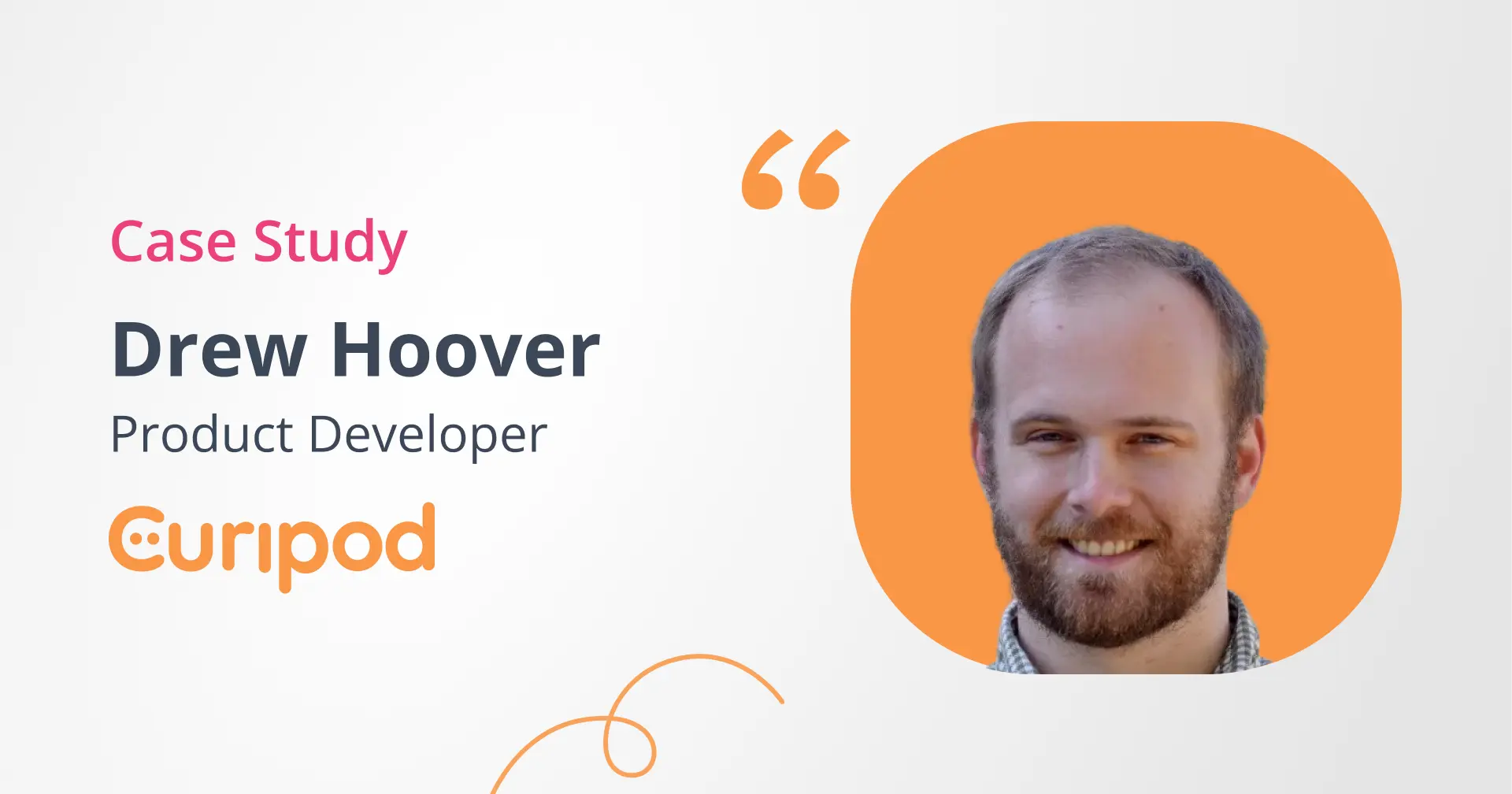
“As a developer, I always think of tools as levers. Is it a long lever or a short lever? Tolgee is a very, very long lever. For the amount of effort you have put in, you generate a lot of force out of it.”
In this story, Drew Hoover, Product Developer at Curipod, shares how his team used Tolgee to ship native localization in more than 20 languages, eliminate hundreds of daily React crashes, and turn localization into a growth lever.
TL; DR
When Curipod decided to take international users seriously, they faced a familiar startup dilemma: half of their users were outside the US, but they only had five engineers and no localization process.
After implementing Tolgee, Curipod:
Shipped their app in 22 languages
Eliminated ~300 daily React crashes from browser translation
Achieved 143% YoY usage growth in Arabic-speaking markets and 83% YoY in Spanish-speaking markets
Unlocked thousands of new international signups
Got featured by the Saudi Arabian Ministry of Education
Here’s how they did it.
Challenge: When Localization Lives Outside Your App
Before adopting Tolgee, localization at Curipod was more of a liability than a growth driver. An earlier localization solution had been partially implemented and then abandoned, leaving translations outdated, inconsistent, and difficult to maintain. English effectively became the default language, with only a neglected Norwegian translation in place. Adding or updating translations was complicated, poorly defined, and not worth the engineering effort required, especially for a small team already stretched thin.
As a result, international users often relied on browser-based translation tools to use the app in their native language. This created a serious technical problem. Browser translators modify the DOM in ways that don’t play well with React, and for Curipod, this led to frequent, app-breaking crashes. At its peak, browser monitoring showed roughly 300 full React crashes per day, triggered not by real bugs in the product, but by automatic translation tools in the browser. This made the app unstable for international users and made it harder for the team to identify and fix genuine issues.

Developer Perspective
From a developer’s point of view, Tolgee fit naturally into Curipod’s existing workflow and immediately delivered a high return on effort. The team didn’t need to introduce a new, complex process or rethink how they built features. Instead, localization became something that happened alongside normal development.
“I haven’t had to haunt people’s pull requests or anything like that.”
Curipod integrated Tolgee using the React SDK and the <T> component, replacing hardcoded string literals with translatable keys and default values. Using Cursor, Drew was able to automate much of this work, systematically updating the codebase and letting Tolgee’s CLI handle synchronization.
“There’s just not that many steps required to go from ‘I wrote some labels in English’ to ‘this is translated into 22 locales that we support.”
AI-First Localization With Control
To move forward, Curipod needed a localization solution that matched the reality of a small, fast-moving engineering team. Strong support for React was essential, along with clear documentation that made it easy to get started and hard to misuse.
AI-powered translations were a must, not a nice-to-have. The team needed to be able to rely on LLMs to do most of the work while still having enough control to fine-tune terminology, handle edge cases, and provide context where it mattered.
That balance proved critical when the Norwegian translation for the word “lesson” didn’t feel right to native speakers. Instead of editing hundreds of strings manually, the team fixed the issue by adjusting the AI context:
Added a short AI context rule specifying which term should always be used for “lesson”
Re-triggered the translations
Fixed the entire interface at once
“Just having that prompt, the AI context, has been super, super powerful and helpful for us. I’m using GPT-5, and I don’t think I’ve actually changed the prompt.”
Tolgee’s in-context translation feature made it possible for people outside the engineering team to contribute to localization in a practical way. Using the browser extension (Chrome or Firefox plugin), team members could hold Alt/Option and click directly on text in the app to update the translation in another language.
Just as importantly, Curipod needed to support right-to-left languages like Arabic and to prevent users from falling back to browser-based translation tools that were breaking the app. The goal wasn’t just to translate the interface, but to deliver a stable, native experience for users in every supported language.
From Localization to Measurable Growth
One of the most immediate wins was stability. Once Curipod shipped native translations and disabled browser-based translation tools, app-breaking crashes disappeared almost overnight. What had previously been hundreds of full React crashes per day dropped to zero, giving the team a clear and reliable signal when real issues occurred. This alone dramatically improved the experience for international users and removed a constant source of noise for the engineering team.
“All of a sudden our front-end error-monitoring dashboard looked very boring"
Beyond stability, localization quickly became a growth driver. By launching support for more than 20 languages, including right-to-left languages like Arabic, Curipod was able to properly serve large international user segments. The results were especially strong in their two largest translation groups. Since implementing Tolgee, Curipod has seen 143% year-over-year usage growth in Arabic-speaking markets and 83% year-over-year growth in Spanish-speaking markets.
These gains weren’t just abstract metrics. Shortly after releasing Arabic localization, Curipod was publicly recommended by the Saudi Arabian Ministry of Education, leading to a significant traffic spike and thousands of new teacher signups. Localization helped establish trust with educators and institutions in new regions, opening doors that simply weren’t accessible with an English-only product.
What started as an effort to improve usability for international users ultimately proved to be a strategic investment.
Over to you!
If you’re a developer building a global product, localization shouldn’t slow you down or break your app. Tolgee lets you ship native translations, integrate AI-powered localization, and scale to dozens of languages with minimal effort.